What Is Travel CRM? A Plain-Language Guide for Travel Agencies
What Is Travel CRM? A Plain-Language Guide for Travel Agencies
Most travel agencies in India already use some form of CRM. Contacts are in Zoho, deals are in a pipeline, and the tool technically works. But the itinerary is still being built in Word. Supplier rates are still in a separate Excel sheet. Leads are still arriving on WhatsApp and sitting in personal chat threads. GST invoices are still being raised in Tally. The CRM is there, but the travel workflow is not inside it.
That gap is exactly what travel CRM is designed to close.
What Is Travel CRM
Travel CRM is software built specifically for travel businesses to manage the full journey from enquiry to booking in one connected system. It brings together lead capture, quotation building, itinerary management, supplier coordination, payment tracking, and operations visibility so that the entire workflow lives in one place rather than across multiple disconnected tools.
The distinction from generic CRM is not about features. It is about what the software was designed to understand. Generic CRM understands contacts, deal stages, and follow-up tasks. Travel CRM understands itineraries, supplier rates, WhatsApp-led enquiries, booking coordination, and GST invoicing. Those are different things, built around different operational realities.
How Travel CRM Differs from Generic CRM Software
A generic CRM manages a sales pipeline. It stores contact details, tracks deal stages, sends email reminders, and logs calls. For a product-based business with a straightforward sales cycle, that is often enough.
A travel agency's sales cycle is not straightforward. The enquiry arrives on WhatsApp. The salesperson builds a custom itinerary, sources supplier rates from three different places, sends a quotation, revises it twice, collects a partial advance, books hotels, generates a voucher, tracks the balance payment, and hands the entire booking to an operations team that manages the trip in real time. None of this happens inside a generic CRM pipeline. The pipeline shows a stage called "proposal sent." Everything that matters is happening elsewhere.
Travel CRM is built around this specific workflow. The enquiry, the quotation, the itinerary, the supplier rates, the booking confirmation, the payment milestones, and the operational coordination all live inside the same system. That is not a feature upgrade on top of a generic CRM. It is a fundamentally different architecture built for a fundamentally different type of business.
For a deeper look at where generic CRM specifically fails travel agencies, see why generic CRM software falls short for travel agencies.
What Travel CRM Actually Does in a Travel Agency Workflow
The clearest way to understand what travel CRM does is to follow a real booking through the system.
Enquiry
Pipeline
and Itinerary
Confirmed
and Invoice
and Departure
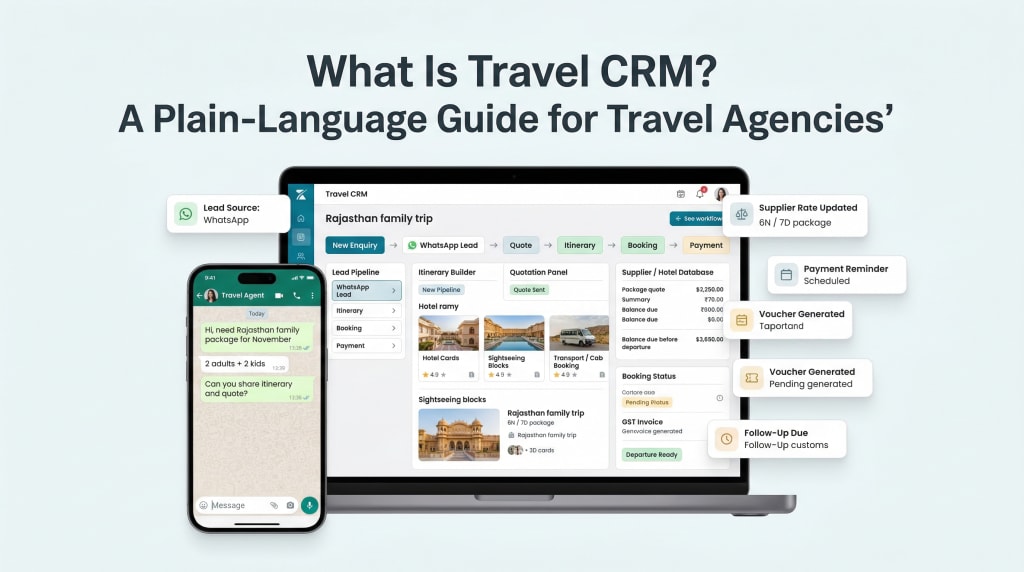
A customer messages the agency on WhatsApp asking about a Rajasthan family trip for November. In a travel CRM, that enquiry enters the lead pipeline directly, with the source, the conversation thread, and the initial details attached. The lead is assigned to a team member, and the conversation history is visible to anyone else on the team.
The agent builds the quotation inside the same system. Supplier rates and hotel information are stored in a central database rather than scattered across Excel sheets and WhatsApp groups. The quotation is versioned and attached to the lead record, so when the customer asks about revision three, anyone on the team can see exactly what was sent and when.
If the customer does not respond within a defined period, the system triggers a follow-up reminder. The agent does not need to remember to check. The prompt exists whether or not the agent thought to create it.
When the booking is confirmed, operations can see the full record without needing the sales team to forward anything. Vouchers are generated from the booking record. Payment milestones are tracked and reminders are sent automatically when a due date approaches. GST invoicing is handled within the workflow rather than passed to a separate tool.
The agency owner, at any point, can see the full pipeline, the upcoming departures, and the payment position without asking anyone for a manual update. This is what travel CRM does. Not abstractly, but operationally, at every stage of a real booking.
What to Look for in a Travel CRM
When evaluating travel CRM options, the question to ask about each capability is not "does it have this feature" but "does it handle this part of our workflow by design or does it require customisation to get there."
A purpose-built travel CRM covers these areas by design. A generic CRM adapted for travel requires customisation to approximate it, and that customisation rarely holds together as the business grows.
Who Needs a Travel CRM
Travel CRM is not relevant to every travel business at every stage. The honest answer to "Does my agency need one?" depends on where the operation currently is.
An agency managing fewer than 15 bookings per month with a small team that knows every booking by name can often manage with a combination of a lead tracker and careful WhatsApp discipline. The manual approach works at low volume.
The point at which travel CRM becomes a practical need rather than a nice-to-have is when the manual approach is consistently causing problems. Leads are going cold because follow-ups depend on individual memory. Itineraries exist in multiple versions across inboxes and drive folders. Operations teams are chasing sales for information that should already be shared. Payment follow-ups depend on someone remembering to check the sheet.
These are structural problems, not discipline problems. They are produced by a system that was not built for the volume and coordination demands of a growing travel business.
For agencies moving from spreadsheets to a connected system, travel CRM is the category of software that resolves this. For tour operators and DMCs managing multi-destination packages, supplier networks, and volume bookings, the case is even stronger. The coordination complexity at that scale makes a connected system a practical necessity.
If your agency is experiencing lead leakage tied to follow-up gaps, see how travel agencies lose leads without a structured system.
How Triplide Approaches Travel CRM
Triplide is a travel CRM built specifically for travel agencies, tour operators, and DMCs. It is not a generic CRM adapted for travel. It is built around the workflow of a travel business from the ground up.
On the lead management for travel agencies side, Triplide captures enquiries from WhatsApp, website forms, Meta Ads, and Google Ads directly into a shared pipeline. Each lead is assigned, tracked, and visible to the full team, with conversation history attached. Follow-up reminders are triggered automatically rather than depending on agents to remember.
Quotations are built inside the platform and connected to the lead record, so revision history and customer responses are accessible to anyone on the team. An AI-assisted itinerary building connected to the lead record supports faster itinerary preparation by drawing on saved destination content and supplier data, reducing the manual effort of rebuilding the same packages from scratch for every new enquiry.
A supplier and hotel database keeps rate information centralised. Payment milestones are tracked against each booking, with GST invoicing supported within the workflow. An operations dashboard gives the team visibility into active bookings, departures, and pending tasks without requiring the sales team to bridge the information gap manually.
For travel businesses that have felt the friction of running sales, itineraries, payments, and operations across disconnected tools, the right starting point is understanding which workflows need to come together first. Most agencies start with lead management and itinerary building, then expand into payment tracking and operations visibility.
Frequently Asked Questions
Travel CRM software manages the full workflow of a travel business from the first customer enquiry to the final booking and payment. It connects lead capture, quotation building, itinerary management, supplier coordination, payment tracking, and operations visibility in one system, reducing the manual coordination that otherwise happens across WhatsApp, spreadsheets, email, and separate invoicing tools.
Yes, in a meaningful way. Generic CRM manages contacts and deal stages but has no concept of itineraries, supplier rate databases, WhatsApp lead capture, booking coordination, or GST invoicing. Travel CRM is built around the specific workflow of a travel business, so these capabilities are part of the system rather than workarounds the team builds around it.
It depends on volume and the problems the team is experiencing. A solo agent with low booking volume can often manage without one. Once a team is handling 20 to 30 or more enquiries per month, managing leads, follow-ups, itineraries, and payments across WhatsApp and spreadsheets typically starts constraining growth rather than supporting it.
The capabilities that matter most are WhatsApp and multi-channel lead capture, an itinerary builder connected to the lead record, quotation workflow with version tracking and follow-up reminders, a supplier and hotel rate database, payment milestone tracking with GST invoicing, an operations dashboard for team visibility, and mobile access. These reflect the core operational needs of a travel agency rather than a generic sales team.
The best travel CRM for an Indian agency is one built specifically for travel workflows rather than adapted from a generic sales tool, and one that reflects Indian operational realities like WhatsApp-led communication, GST invoicing, and supplier coordination. Triplide is built for this, though the right choice depends on team size, booking volume, and the specific workflows the agency needs to centralise.
Travel CRM Is Not a Buzzword
Travel CRM is not a buzzword for an upgraded contact database. It is a category of software built around the specific, complex, multi-stage workflow of a travel business, from the WhatsApp enquiry that arrives at 9 pm to the voucher sent three weeks later and the GST invoice that follows.
The agencies that find it most useful are the ones where the manual coordination holding the current system together is already costing more time and creating more errors than the team can comfortably absorb. Understanding what the category is and what it actually does inside a travel workflow is the right starting point. From there, the question becomes which system does it in a way that fits how the agency already works.
Built for Travel, Not Adapted Later
Triplide is a travel CRM designed for agencies, tour operators, and DMCs. See how it handles the full workflow from enquiry to booking.
Book a Free Demo


